Glutathione in Research: Antioxidant Pathways and Handling
November 11, 2026
Glutathione is the most abundant low-molecular-weight thiol in mammalian cells, and it anchors much of the intracellular antioxidant system. For researchers studying oxidative stress, redox signaling, or detoxification pathways, it's a reference molecule you'll encounter constantly. It's also a tripeptide that degrades readily if you mishandle it, which makes storage and reconstitution worth understanding before you open a vial.
This post covers the chemistry that makes glutathione useful in the lab, the quality-control methods you'll see reported on a certificate of analysis, and the handling practices that keep a reduced thiol reduced. Everything here is framed for research use only. These compounds are not for human consumption, and nothing below describes dosing, administration, or therapeutic use.
What Glutathione Is, Chemically
Glutathione is a tripeptide: gamma-glutamyl-cysteine-glycine. The unusual gamma peptide bond between glutamate and cysteine resists cleavage by standard peptidases, which is part of why the molecule persists intracellularly. The functional heart of the molecule is the cysteine thiol (-SH), which is where its redox activity lives.
Two forms matter in practice:
- GSH (reduced glutathione) — the active antioxidant form, carrying a free thiol.
- GSSG (oxidized glutathione) — two glutathione molecules joined by a disulfide bond.
The ratio of GSH to GSSG is one of the most widely used readouts of cellular redox state. A high GSH:GSSG ratio reflects a reducing intracellular environment; a drop in that ratio is a common marker of oxidative stress in cell and tissue models.
Peptide Depot supplies glutathione described as the body's most abundant endogenous antioxidant, with research focused on oxidative stress reduction, detoxification pathways, and immune signaling. For research use only. Not for human consumption.
Antioxidant Pathways Researchers Study
Glutathione participates in several enzymatic systems, and most research designs touch at least one of them.
The glutathione peroxidase / reductase cycle
This is the core redox loop. Glutathione peroxidase (GPx) uses GSH to reduce hydrogen peroxide and lipid peroxides to water and alcohols, oxidizing GSH to GSSG in the process. Glutathione reductase then regenerates GSH from GSSG using NADPH as the electron source. Studying this cycle usually means tracking GSH:GSSG ratios, GPx activity, and NADPH availability together.
Detoxification via glutathione S-transferases
Glutathione S-transferases (GSTs) conjugate GSH to electrophilic and xenobiotic compounds, tagging them for elimination. This is a major focus in toxicology and drug-metabolism research, where glutathione conjugation assays help characterize reactive metabolites.
Thiol buffering and protein glutathionylation
Glutathione also reversibly modifies protein cysteine residues (S-glutathionylation), a post-translational modification that regulates enzyme activity and protects thiols from irreversible oxidation. This links glutathione to redox signaling, not just bulk antioxidant capacity.
Glutathione research often sits alongside work on NAD-dependent and mitochondrial pathways. Labs studying cellular energy and oxidative stress sometimes examine it in parallel with NAD+ or mitochondria-targeted compounds, since redox balance and energy metabolism are tightly coupled.
Why Handling Matters: The Thiol Problem
The free thiol that makes reduced glutathione useful is also its weakness. Expose GSH to air, moisture, metal ions, or warm temperatures, and it oxidizes to GSSG. If your experiment depends on reduced glutathione, uncontrolled oxidation silently shifts your starting material before the assay even begins.
Practical consequences:
- A vial labeled as reduced glutathione can contain a drifting GSH:GSSG ratio if it's been stored or handled poorly.
- Trace metal contamination accelerates oxidation. Copper and iron ions catalyze thiol oxidation, which is why some workflows use metal chelators in buffers.
- Repeated freeze-thaw cycles degrade solutions and concentrate oxidation damage.
For these reasons, redox-sensitive assays often prepare glutathione solutions fresh and include controls that measure the actual GSH:GSSG ratio rather than assuming it.
Storage and Stability
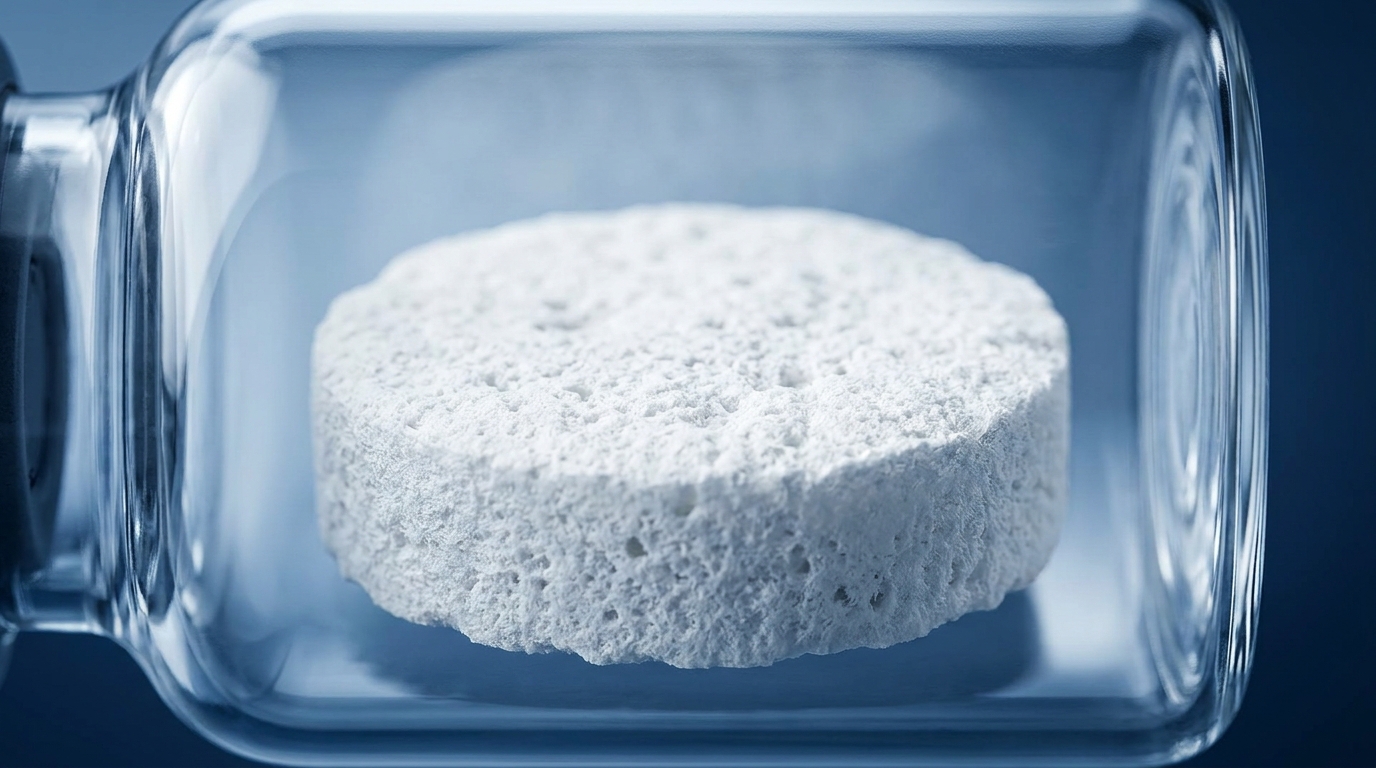
Glutathione is typically supplied as a lyophilized powder, which is the most stable form. General handling practices researchers follow:
- Store lyophilized powder cold. Many labs keep it at -20°C, protected from light and moisture, for long-term storage. Refer to the supplier's stated conditions for the specific product.
- Keep it dry. The powder is hygroscopic; let a sealed vial reach room temperature before opening to avoid condensation drawing moisture in.
- Reconstitute shortly before use when the reduced form matters. In solution, glutathione is far less stable than as a powder.
- Aliquot reconstituted material to avoid repeated freeze-thaw. Single-use aliquots protect the thiol and preserve a consistent redox state across experiments.
- Consider buffer chemistry. Slightly acidic, metal-free buffers slow oxidation compared with neutral or alkaline solutions exposed to air.
Researchers often use a Peptide Calculator to standardize concentrations across experiments, which keeps working solutions consistent from one run to the next.
How to Read a Glutathione Certificate of Analysis
A certificate of analysis (COA) is your first objective check on what's actually in the vial. For glutathione, these are the sections worth reading closely.
Identity (mass spectrometry)
Mass spectrometry confirms the molecular weight matches glutathione (307.3 g/mol for the reduced form). This verifies you have the right molecule and not a mislabeled or substituted compound.
Purity (HPLC)
High-performance liquid chromatography reports purity as a percentage of total peak area. Common research-grade thresholds are 95%, 98%, and 99%. A good HPLC trace also reveals the presence of related impurities — and for glutathione specifically, a well-resolved method can distinguish reduced from oxidized forms. If a COA reports a purity figure, note which method and form it refers to.
Water content (Karl Fischer titration)
Because glutathione is hygroscopic, Karl Fischer titration quantifies residual moisture. High water content accelerates degradation and skews mass-based calculations.
Appearance and solubility
Most COAs note physical form (white to off-white powder) and solubility notes. These are basic sanity checks against contamination or degradation.
Treat a COA as a compound-level report. On Peptide Depot, published COAs come from Janoshik Analytical and are available for some products — always confirm which document applies to the product you're evaluating. When sourcing from any supplier, it's reasonable to ask for a COA from an independent analytical lab and to confirm the testing method behind any purity figure. None of these documents certify a compound for in vivo or animal use.
Common Mistakes When Working With Glutathione
- Assuming reduced means reduced. A powder or solution can carry significant GSSG. If your assay depends on GSH, measure the ratio rather than trusting the label.
- Ignoring metal contamination. Trace copper or iron in water or buffers quietly oxidizes your thiol. Use high-purity water and consider a chelator.
- Letting solutions sit. Reconstituted glutathione degrades in hours to days depending on buffer and temperature. Prepare fresh when possible.
- Over-freezing. Each freeze-thaw cycle costs you. Aliquot once, thaw once.
- Skipping the COA. Without identity and purity confirmation, you're building an experiment on an assumption.
Frequently Asked Questions
What is the difference between reduced (GSH) and oxidized (GSSG) glutathione?
Reduced glutathione (GSH) carries a free cysteine thiol and is the active antioxidant form. Oxidized glutathione (GSSG) is two glutathione molecules joined by a disulfide bond. The GSH:GSSG ratio is widely used as a readout of cellular redox state, with a lower ratio indicating oxidative stress.
How should glutathione be stored in a research lab?
Lyophilized glutathione powder is typically stored cold, often at -20°C, protected from light and moisture. It is hygroscopic, so let a sealed vial reach room temperature before opening to avoid condensation. Reconstitute shortly before use when the reduced form matters, and aliquot solutions to avoid repeated freeze-thaw cycles. Always follow the supplier's stated conditions.
Why does glutathione oxidize so easily?
The free thiol group that gives reduced glutathione its antioxidant activity is reactive. Exposure to air, moisture, warm temperatures, or trace metal ions like copper and iron catalyzes its oxidation to GSSG. Using high-purity, metal-free buffers and preparing solutions fresh helps slow this process.
What QC methods appear on a glutathione certificate of analysis?
A typical glutathione COA reports identity by mass spectrometry (confirming the molecular weight), purity by HPLC as a percentage of peak area, and water content by Karl Fischer titration. Some also note appearance and solubility. These are compound-level analytical reports and do not certify a compound for in vivo or animal use.
Is Peptide Depot glutathione safe to use in humans?
No. Glutathione sold by Peptide Depot is for laboratory research use only and is not for human consumption. It is not supplied, labeled, or tested for any therapeutic, diagnostic, or human use.
Final Notes
Glutathione is a workhorse molecule in redox research, but it rewards careful handling. Understand the GSH:GSSG distinction, control for oxidation, and verify identity and purity against a COA before you build data on it. Peptide Depot is a Canadian supplier offering glutathione and a broader catalog of research compounds, all for research use only and not for human consumption. For more on sourcing and handling, see the FAQ.